2025 On the Brinck Book Award + Lecture Winners Announced
February 9, 2026
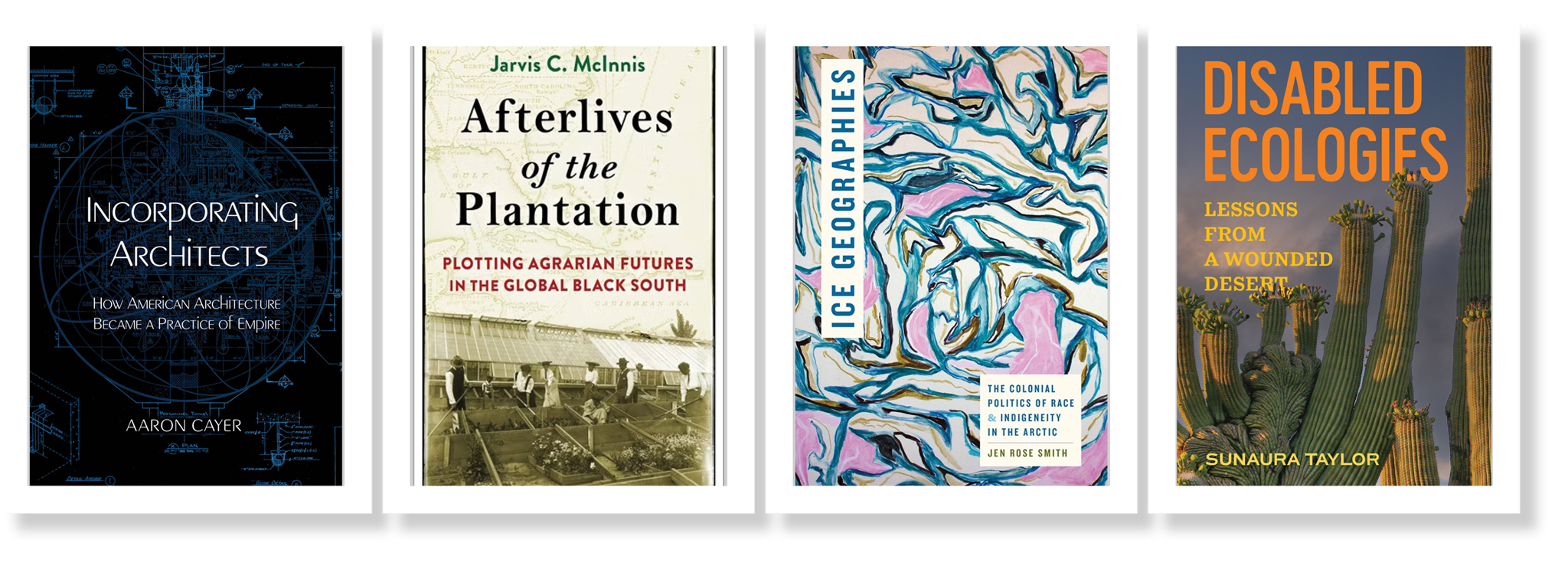
The University of New Mexico School of Architecture + Planning (SA+P) is pleased to announce the winners of the 2025 On the Brinck Book Award and Lecture series, created in honor of John Brinckerhoff Jackson. The jury, comprised of Irene Cheng, Felipe Correa, Margaret Crawford, David Gissen, Catherine Page Harrris, Cathy Lang Ho, and Thaïsa Way, honors the following publications:
Aaron Cayer, Incorporating Architecture: How American Architecture Became a Practice of Empire, UC Press, 2025.
Jarvis C. McInnis, Afterlives of the Plantation: Plotting Agrarian Futures in the Global Black South, Columbia University Press, 2025.
Jen Rose Smith, Ice Geographies: The Colonial Politics of Race and Indigeneity in the Arctic, Duke University Press, 2025.
Sunarua Taylor, Disabled Ecologies: Lessons from a Wounded Desert, UC Press, 2024.
UNM SA+P Dean Robert Alexander González founded the program as a Dean’s Initiative in 2020. He notes: “This award is supported by a generous endowment established by J.B. Jackson toward the end of his life. In his spirit, it affirms our commitment to promoting enlightened approaches to scholarship that emphasize new and overlooked areas of study, accessibility to the reader, and the integration of the allied disciplines we study at the School of Architecture + Planning.”
The awarded volumes embody the legacy of J.B. Jackson, a prolific writer and influential figure in the development of the field of cultural landscape studies, merging analysis of natural, built, and human landscapes. The selected works contribute new knowledge and perspectives spanning the design disciplines of architecture, landscape architecture, planning, and urban design. Together they serve as a collection that can help students, faculty, and practitioners expand design and planning discourse and open new discussions on ways of viewing and knowing.
Coordinating juror, Associate Professor of Landscape Architecture and J.B. Jackson Endowed Chair, Catherine Page Harris notes: “The four winning volumes exemplify embodied research embedded in place. Ice, deserts, plantations, and the corporate office are articulated with laser focused details and expanded in their global reach.”
The School of Architecture + Planning will host the authors for a symposium on Monday, April 27, 2026, from 3-5 in the Garcia Auditorium in Pearl Hall. Authors will present their books and discuss their work in the context of J.B. Jackson’s legacy and contemporary issues within design and planning. Please visit our website for more information on the winners and past winners.
The following jury comments encapsulate the award program’s thematic connection to J.B. Jackson’s historic contributions:
Cayer, Aaron, Incorporating Architecture: How American Architecture Became a Practice of Empire, UC Press, 2025
Cayer’s Incorporating Architecture takes on an important and understudied topic, the business of architecture. Cayer lays out a scale and history of a practice and introduces the context of the larger economy and various national and international trends that influence the growth of AECOM. In particular, AECOM’s embrace of military landscapes and installations including the Trident missile is fascinating. This relevant volume traces how AECOM’s concept of “total planetary practice” changed architecture. The scale of projects discussed sheds unexpected light on takeovers and mergers of AECOM, delineated through oral histories and on the ground reporting. This excellent example of research methods persists when Cayer is denied access to official archives causing him to turn to personal relationships and boxes of marginalia. This is a very good study of a practice and will illuminate for students the corporate side of the architectural practice. This book embeds its reader in the drama of the mundane in a manner that humanizes the people drafting and laboring in the service of Pelli’s aesthetic of the expanse.
McInnis, Jarvis C., Afterlives of the Plantation: Plotting Agrarian Futures in the Global Black South, Columbia University Press, 2025
The jury celebrates McInnis’ well-researched, beautifully written, and ground-breaking work that crosses disciplines to be a fresh take on place and African American histories. He argues for the rural South as a space of resistance embodied through the plantation that becomes Tuskegee Institute/University. Describing the founding practices of Booker T. Washington and his teaching about agriculture and culture, McInnis develops an argument for the reframing of successful agriculture as rebellion against the monocropping and environmental devastation wrought by the human devastation of enslavement as well as a way to lay claim to place. Using eco-ontologies as a theoretical frame, this place-based narrative weaves documents and art from Zora Neale Hurston alongside other writers/designers into the archives. This work knits a narrative that fits the place-based criteria of this award in a broad swath of new knowledge around black modernity.
Smith, Jen Rose, Ice Geographies: The Colonial Politics of Race and Indigeneity in the Arctic, Duke University Press, 2025
Smith investigates ice as a material, as a place, and as an ideology. In a concise, effective, and well researched narrative, she changes how we think about land/water/ice, turning around conceptions of dead, lifeless, spaces to rich inhabited arctic places. In a literal new materialism, Smith’s ice has agency in her indigenous ontologies of the Arctic. This volume weaves multi-disciplinary modes of expression from lyric reflection to art critique to place based politics. The jury appreciated the description of local, detailed, and lived-in places as well as Smith’s expansive theory of the connections of those places through the conditions of arctic-ness. This book makes a definitive contribution by pushing back assumptions about people who live in, around, and on ice and the nature of those places themselves. In the context of climate change and the rapid disappearance of ice, Smith’s work offers engagement beyond memorialization using a framework she calls “careful guesswork.” This work weaves a startling and embodied relationship to ice for her readers in an excellent mix of approaches to environmental humanities research, material studies, and indigenous studies research.
Taylor, Sunarua, Disabled Ecologies: Lessons from a Wounded Desert, UC Press, 2024
The jury applauds Taylor’s work bringing together various fields of studies: civil rights, decolonialism, ethnic studies, environmental studies, and health, in a convincing mixture of best practices in environmental justice research and disability studies. Taylor weaves many scales into a single narrative. She investigates this one place, the Tucson desert, from its involvement in global wars through weapons manufacture and export to intimate bodily impacts of dumping trichloroethelyne in a place she shows as layered, inhabited, and intricate. She redefines the desert “blank slate” as deep with aquifers and stories, both personal and informative, not a dump for toxic materials. Taylor’s desert form is replicated in her complex but readable footnote system and the inclusion of poems and paintings as multiple forms of expression in this researched work. This personal and informative narrative teaches an ethic that values the earth that has been impacted rather than dismissing it as impure or having no wilderness value. Disability studies are a lens for landscapes; the discussion is not about universal access to wilderness, but about values around impairment, seeing the landscape as a body to be respected in all its states.